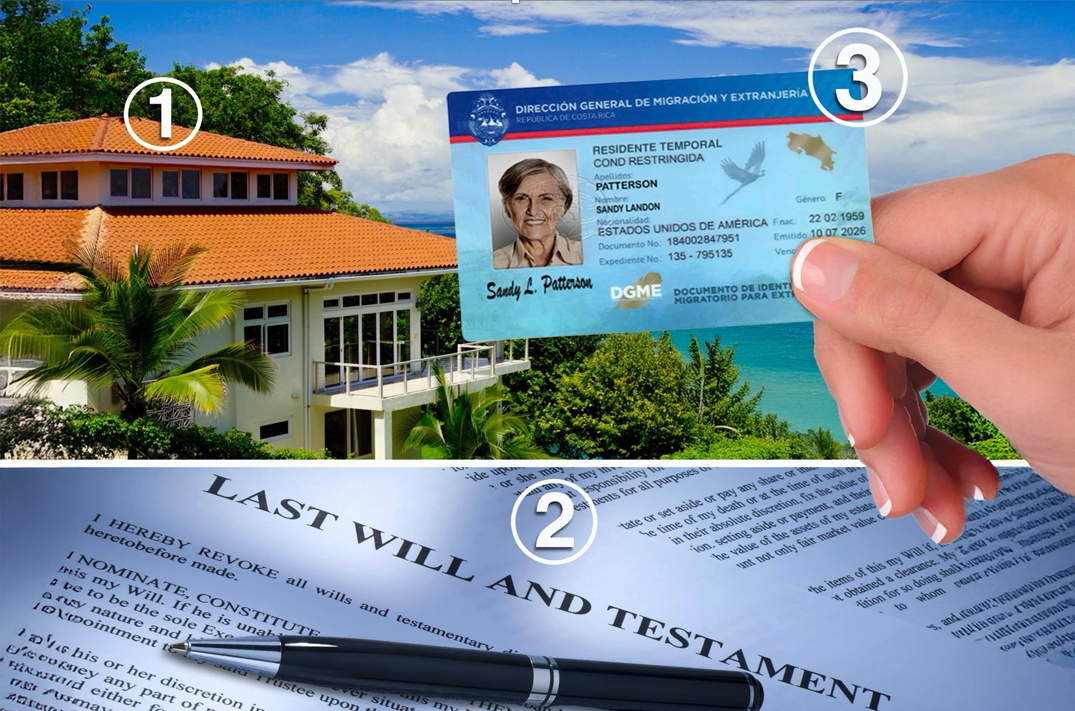
How They Are CLOSELY Linked
A must-read for any Expats investing or planning to invest and live in Costa Rica
As an Expat enjoying life in Costa Rica, you likely own or will acquire assets here—real estate, bank accounts, vehicles, investments, or a business.
Without a local will that covers those Costa Rican assets, your estate could face delays, disputes, or unintended outcomes under Costa Rican succession law at a time your surviving loved ones are least equipped to deal with such complications.
Simultaneously, you also need to properly set up ownership of assets you intend to use to qualify for Investor Residency.
An often overlooked parallel consideration.
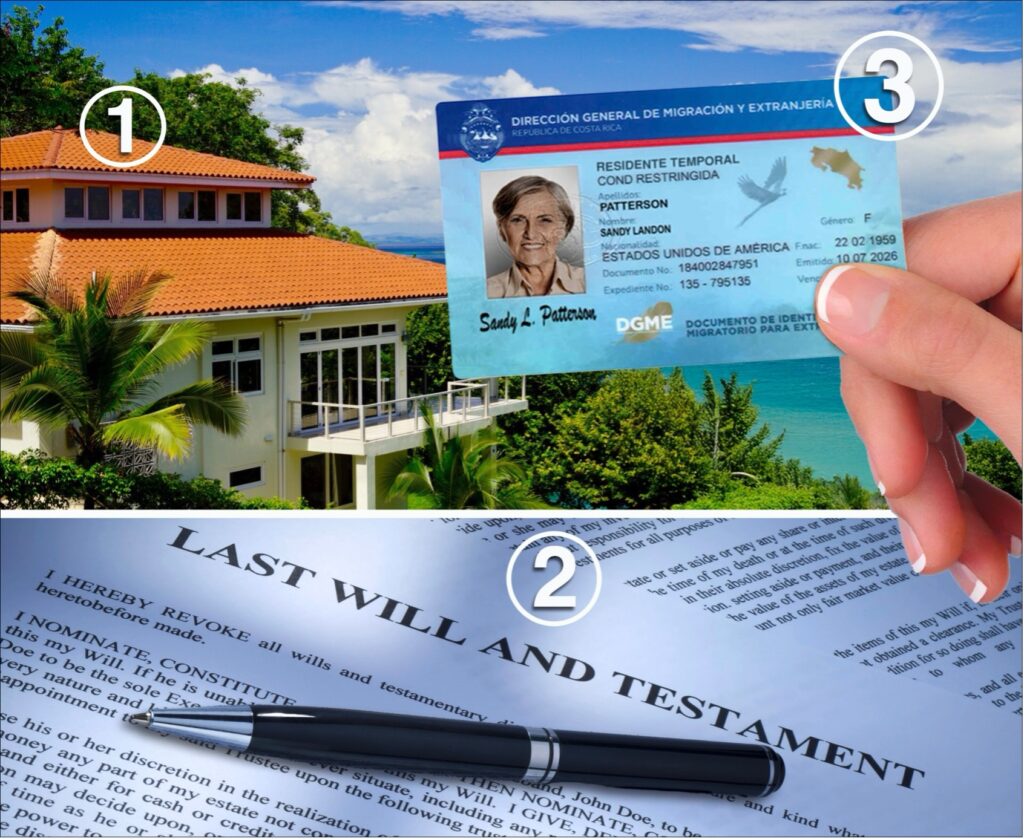
Here’s the sequence:
- Purchase assets and properly and set up the ownership of those assets to conform to the Costa Rica Department of Immigration rules for Inversionista residency.
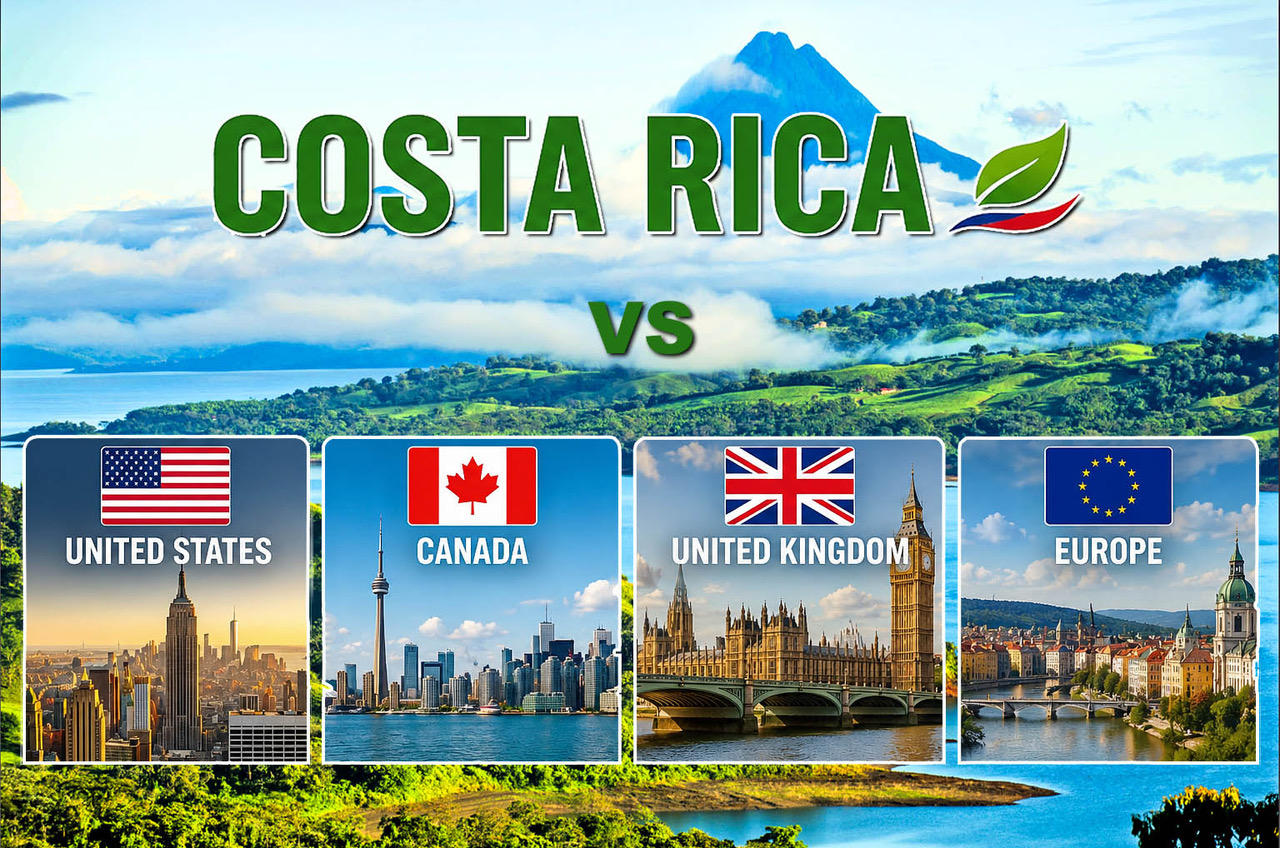
- Cover those assets with a Costa Rica will. (Your U.S., Canadian, EU, or UK, etc. will, will not cover those assets in Costa Rica.)
- Apply and qualify for Inversionista (Investor) legal residency.
Costa Rica Immigration Rules for Inversionista (Investor) Residency
Very frequently overlooked by realtors and real estate lawyers!
(Invest three minutes of reading time and save tens of thousands of $$$ & massive frustration.)
Inversionista Residency: How to Qualify
Requires an investment in assets within Costa Rica of at least USD 150,000 of provable value. The letter of the law translates in English to: “The investment amount must be $150,000 United States dollars or more according to the official exchange rate, which is established by the Central Bank of Costa Rica. The investment can be made in tangible property, shares, negotiable instruments, productive projects, or projects that are deemed of national interest.”
Most often, applicants qualify for the Inversionista (Investor) residency category based on property assets they own directly or through an active corporation. (One that reports and pays taxes on income produced through the asset, such as rental property).
If the value of an asset falls short of the minimum, other registered assets with provable values, such as land, cars, trucks, and ATVs, can be used to “top up” the asset mix to get an applicant over that 150K minimum. Further, at the time of submitting the application for Inversionista residency, the main applicant must also provide proof that the active corporation has generated at least USD 15,000 in income to be considered a serious corporation. (Also overlooked by most lawyers handling real estate ownership setups.)
NOTE: That 150K minimum is LIKELY to be increased back to the previous USD 200K in the upcoming months of 2026. (So if you are sitting on the fence… tik-tok, tik-tok.)
If applying through an active Corporation:
The principal residency applicant applying as an Inversionista owns at least USD 150K in shares of the active corporation in Costa Rica, which owns the property. (IE, A husband and wife who own equal shares totaling 250K do not qualify. One or the other must own at least USD 150K outright. So joint ownership must equal or exceed USD 300K in share value.)
If applying through direct ownership:
The main applicant for Inversionista Residency must prove direct ownership of at least USD 150K worth of assets in their name. Again, joint ownership is fine, but it must be valued at at least USD 300K.
Setting up any type of ownership is a complex process handled only by experienced professionals who also understand the rules for applying for Inversionista residency.
Be thorough in vetting them.
Do not be in a hurry because of the tedium of the process or some sort of “friend recommended” choice.
Assume nothing.
Conformity to the applicable rules and excellent documentation leads to the most expeditious approvals for residency applications. Bored, underpaid lawyers in the Department of Immigration handling shoddy documentation all day long are easily irritated and have a lot of discretion to stamp a big “NO!” on your application.
Not sure who to trust with this highly impactful task?
Contact me, and I will steer you to a highly competent and trustworthy real estate lawyer to serve you properly.
Note: When it comes to CAJA monthly premium calculations, Inversionista often provides the greatest advantage over Rentista. That can add up to a very significant economic difference.
WILLS
Why expats need a Costa Rica–specific will.
- Protect Costa Rican assets first: Real estate and local bank accounts are subject to Costa Rican law. A will drafted for your home country may not address Costa Rican formalities or forced heirship rules.
- Avoid intestacy complications: If you die without a will, Costa Rican law determines how your assets are distributed. This can surprise surviving spouses, partners, or other loved ones who may not be named in a foreign will.
- Smooth probate and transfers: A Costa Rica–specific will often streamlines probate, reduces delays, and provides clearer instructions to local executors or trustees.
- Respect local inheritance rules: Costa Rica recognizes legal protections (forced heirship) for certain relatives. A well-drafted local will helps you comply with these rules.
- Coordination with foreign assets: If you have a home country will, a local Costa Rican will enables you to work in harmony with it, ensuring your foreign and Costa Rican estates are coordinated rather than conflicting.
Assets in Costa Rica that should be covered
- Real property (land, houses, condo units) registered in Costa Rica
- Bank accounts held in Costa Rican banks
- Investments, certificates of deposit, or local brokerage accounts
- Shares or ownership in Costa Rican businesses
- Vehicles registered in Costa Rica
- Life insurance policies with beneficiaries in Costa Rica
- Personal possessions with local value (jewelry, collections) and digital assets tied to Costa Rican accounts
- Trusts or foundations established in or linked to Costa Rica
- Note: A comprehensive inventory helps determine whether to use a Costa Rica will alone or a combination (mirror wills or a coordinated plan with your home country).
Costa Rica’s will types and how they work
Costa Rica recognizes several types of wills, typically executed or witnessed by a notary or in accordance with civil law procedures:
- Testamento público (public will): Prepared before a Costa Rican notary with witnesses. This offers strong probative power and is commonly used for real estate and other assets in Costa Rica.
- Testamento cerrado (sealed/closed will): A sealed document prepared for a notary, often opened and probated in court with witnesses. Useful when you prefer privacy but still want formal CR validation.
- Testamento ológrafo (holographic/written will): Entirely handwritten, dated, and signed by you. Typically recognized if validly executed, but may be subject to stricter scrutiny or require translation and validation in CR courts.
Key takeaway:
IIf you own Costa Rican assets, a notary-guided public or closed will is commonly recommended to ensure proper formality and probate efficiency.
ALWAYS consult a local attorney to choose the best type for their situation.
Contact me for a highly recommended professional.
Legal considerations for expats
- Forced heirship (legítima): Costa Rica has protections for certain heirs (e.g., spouse and legitimate children). Your will cannot completely disinherit these heirs; planning around legítima is essential.
- Language and translation: Wills for Costa Rican assets are typically in Spanish. If your will is drafted abroad (e.g., English), you’ll likely need an official Spanish translation and validation in Costa Rica.
- Notarization and recordkeeping: For testamento público or cerrado, a Costa Rican notary handles execution and storage. This helps ensure authenticity and makes probate easier.
- Coordination with foreign wills: A separate will for foreign assets is common. A competent local attorney can help align the two documents to minimize conflicts and ensure that Costa Rican assets pass as intended.
Coordinating foreign and Costa Rican wills
- Mirror or complementary wills: Some expats use separate wills for domestic (Costa Rica) and foreign assets. Ensure they do not contravene each other and avoid duplicative or conflicting dispositions.
- Choose a local executor: Appoint a Costa Rican executor or fiduciary who understands local laws and probate processes.
- Clarify asset-specific provisions: Explicitly identify which assets fall under the Costa Rica will and how they should be distributed, including any guardianship or trusteeship arrangements if dependents are involved.
- Seek specialized advice: A lawyer experienced in cross-border estate planning can help you navigate both jurisdictions, maintain coherent tax considerations, and prevent post-death complications.
That’s an extremely short list of qualified lawyers!
Contact me for a highly recommended professional.
How to create a Costa Rica will (practical steps)
- Gather property deeds, bank statements, ownership certificates, business interests, insurance policies, and identification documents.
- Discuss with your attorney whether a testamento público, cerrado, or ológrafo (or a combination with a foreign will) best suits your needs.
- Ensure the document complies with CR formalities. If you have a foreign will, arrange for a sworn translation into Spanish.
- The chosen type will be executed in the presence of the appropriate notary and witnesses as required.
- Choose someone reliable in Costa Rica to administer the estate.
- Notaries and lawyers can advise on secure storage and any registry implications for real estate.
- Life changes (property acquisitions, marriages, divorces, births) warrant updates to keep the plan current.
Probate process and timelines (Costa Rica)
- For real estate and other Costa Rica assets, probate proceeds through local courts or notarial channels, depending on the type of will.
- Properly executed Costa Rica wills generally facilitate a smoother transfer of assets to heirs or beneficiaries.
- Processing times vary by case complexity, location, and court workload. Your executor and attorney can provide realistic timelines.
- International assets remain subject to the relevant laws of their jurisdiction; coordination is essential to minimize conflicts and delays.
Reminder:
My work is focused entirely on helping people successfully obtain legal residency or citizenship in Costa Rica. I am not distracted by other competing disciplines.
I don’t handle real estate or wills – BUT – I can steer you to a highly reliable professional to handle such matters.
I’m sharing this as a courtesy for those planning to apply under the Inversionista (Investor) residency program.
Over the past couple of years—especially since the rules changed—I’ve seen many people run into the same frustrating situation: they’ve already purchased property or made an investment, only to discover later that their ownership structure doesn’t actually qualify for residency.
In many cases, this happens because the real estate setup was done without considering Costa Rica’s immigration requirements. Unfortunately, fixing it afterward can mean delays, extra legal work, and high additional costs.
Another common issue? Many people simply haven’t put a Costa Rican will in place—something that can create serious complications for their assets here.
The good news is that both of these problems are completely avoidable with the right planning from the start.
Take a few minutes to review these points carefully.
A little preparation now can save you significant time, money, and stress later—and put you in the best possible position to qualify for Inversionista residency without surprises.
Pura Vida